• Skip to main content
  • Skip to primary sidebar
Career Building Jobs

Career Building Jobs

CV, Interview and Job Application Tips

CV Help

How to Write a Project Coordinator CV (With Examples)

October 3, 2023 by Mike Jacobsen

Writing a CV or resume might seem like a daunting task, especially for a role as pivotal as a Project Coordinator. But don’t worry, we’ve got your back! In this article, “How to Write a Project Coordinator CV / Resume (With Examples)”, we’re going to walk through a straightforward guide that will help you put your best foot forward. From showcasing your project management skills to highlighting your key achievements, we’ll explore practical tips and provide examples to help you craft a CV that not only reflects your capabilities but also catches the eye of hiring managers. Whether you’re a seasoned professional or stepping into the world of project coordination for the first time, this guide is designed to navigate you through creating a CV that stands out. So, let’s dive in and get started on paving the way to your next role!

Project Coordinator CV Template

Contents

  • 1 Read The Job Description / Advert
    • 1.1 Project Coordinator Job Description Example
  • 2 Research The Company
  • 3 Find A Good CV Template
  • 4 Write 2 Or 3 Bullet Points As A ‘Professional Summary’
    • 4.1 Project Coordinator Professional Summary Example
  • 5 Detail Your Employment History
  • 6 Detail Your Education History
  • 7 CV Structure
  • 8 WHAT NOT TO DO
  • 9 Project Coordinator CV Tips – Recap
  • 10 Project Coordinator CV Sample

Read The Job Description / Advert

The first step is, of course, to read the job description. We need to know what the firm is looking for so that we can properly highlight these characteristics in our CV. So read back over the job description and try to pinpoint the important points. A lot of times a firm will call things “required”; if you see this, you need to make sure you include that in your CV. Similarly, if certain things are repeated throughout the advert, this indicates they are of high importance, so we will want to make sure our CV shows that as well.

When performing this analysis, take care to copy the ‘exact’ words and phrases that are being used by the hiring manager. We will want to pepper these into our CV later.

Project Coordinator Job Description Example

Join Our Team: Project Coordinator Wanted!

Are you a dynamic, organized, and results-driven individual with a knack for steering projects to successful completion? We’re on the hunt for a Project Coordinator to join our vibrant team and help us navigate through the exciting projects we have lined up!

About the Role:

As a Project Coordinator, you will play a crucial role in facilitating the smooth execution of our projects from inception to completion. You will work closely with project managers and other team members to ensure that all project activities are conducted on time, within scope, and aligned with our quality standards.

Key Responsibilities:

  • Coordinate project activities, resources, equipment, and information
  • Break projects into doable actions and set timeframes
  • Liaise with clients to identify and define project requirements, scope, and objectives
  • Assign tasks to internal teams and assist with schedule management
  • Make sure that clients’ needs are met as projects evolve
  • Help prepare budgets
  • Analyze risks and opportunities
  • Oversee project procurement management
  • Monitor project progress and handle any issues that arise
  • Act as the point of contact and communicate project status to all participants
  • Work with the Project Manager to eliminate blockers
  • Use tools to monitor working hours, plans, and expenditures
  • Issue all appropriate legal paperwork (e.g., contracts and terms of agreement)
  • Create and maintain comprehensive project documentation, plans, and reports

What We’re Looking For:

  • Proven work experience as a Project Coordinator or similar role
  • Experience in project management, from conception to delivery
  • An ability to prepare and interpret flowcharts, schedules, and step-by-step action plans
  • Solid organizational skills, including multitasking and time-management
  • Strong client-facing and teamwork skills
  • Familiarity with risk management and quality assurance control
  • Strong working knowledge of Microsoft Project and Microsoft Planner
  • Hands-on experience with project management tools (e.g., Basecamp or Trello)
  • BSc in Business Administration or related field
  • PMP / PRINCE2 certification is a plus

Why Join Us?

We offer a vibrant and inclusive environment where you will be challenged, appreciated, and valued. We provide our team members with competitive compensation, a variety of perks, and the opportunity for career advancement. If you’re looking to build your career and take on new challenges, then you might just be the person we’re looking for!

Ready to steer the ship? We can’t wait to meet you!

Note: We are an equal opportunity employer and value diversity at our company. We do not discriminate on the basis of race, religion, color, national origin, gender, sexual orientation, age, marital status, veteran status, or disability status.

Research The Company

Time to put on your detective hat and do some research on your target company. Look at their website, LinkedIn, Twitter, Facebook, and other platforms. You are looking for any piece of intel that will give you the leg up.

  • Find out about recent work/projects they have undertaken or will be embarking on (highlight your experience in these areas on your CV)
  • Find out what software/processes they use and make sure you include your proficiency in them in your CV
  • Learn what interview questions you might expect should you make it that far

See if you know anyone who works there and/or connect (LinkedIn) with people ahead of the interview. A little nepotism could never hurt, and you might be able to glean more information about the role/hiring process in the meantime.

Find A Good CV Template

When selecting a CV template, it’s essential to opt for a simple design and structure. Not only are straightforward layouts more compatible with Applicant Tracking Systems (ATS), but they also make it easier for recruiters and hiring managers to quickly identify and understand key details. A clutter-free and organized CV ensures that your most important information stands out, facilitating a smoother review process for potential employers.

This is the CV template that we recommend (click here)

Write 2 Or 3 Bullet Points As A ‘Professional Summary’

A handy approach is to craft three sentences: the first highlighting your qualifications and experience, the second showcasing your biggest professional achievement, and the third detailing your most recent experience.

Project Coordinator Professional Summary Example

  • With a rich foundation of 8 years in project coordination, backed by a Bachelor’s degree in Project Management and a PRINCE2 certification, I have successfully navigated through the complexities of project lifecycles, ensuring timely and within-budget delivery while maintaining the highest quality standards across various sectors including IT, healthcare, and construction.
  • Instrumental in leading the “GlobalTech” project, which involved coordinating across five international teams and managing a budget exceeding $5 million, I ensured its triumphant completion three weeks ahead of schedule, resulting in a 20% increase in client acquisition and a notable enhancement in client satisfaction metrics.
  • In my most recent role as a Project Coordinator at a renowned IT solutions provider, I was entrusted with overseeing a team of 15, managing end-to-end project activities for developing and launching three innovative software products, which collectively generated a revenue uplift of $2 million within the first year of launch.

Detail Your Employment History

Begin by listing your employment history in reverse chronological order, starting with your most recent role. This allows potential employers to see your recent experience upfront, which holds greater value. Keep in mind that brevity is key.

As you go further back in time, reduce the level of detail to ensure your CV doesn’t exceed two pages. Employers are less likely to read lengthy CVs.

When jotting down your responsibilities on your CV, especially for a Project Coordinator role, make sure they tell a story of your achievements. Instead of just mentioning your duties, like “Handled project scheduling”, try to add some impact to it. For example, you might say “Coordinated the schedules of 10+ projects simultaneously, ensuring 100% on-time delivery over a two-year period”. This way, you’re not just listing what you did, but also showing how well you did it. It tells your potential employer not only about your responsibilities but also about your capabilities and successes, making your CV stand out in a sea of applicants. Remember, it’s not just about what you did, but how well you did it and what the results were. So, always try to highlight your achievements alongside your responsibilities.

Detail Your Education History

Keep your CV concise, aiming for a two-page limit. The education section can often be streamlined.

Highlight the most relevant qualifications. For instance, if you have a degree, your A-levels become less significant. Similarly, if you’re in the U.S., having an MBA overshadows your high school GPA.

Unless an older educational milestone is crucial for the job or highly pertinent, focus on showcasing your Bachelor’s degree, post-graduate studies, or professional certifications. If you lack these, mention your latest qualifications. Remember, having a Master’s suggests you’ve finished school, so no need to state the obvious. Only include your educational background if it’s pertinent to the job.

CV Structure

Tactically structure your CV to the ‘most wanted’ attributes of the job description. For example, if the job description values “qualified”, then place your qualifications first; if they want someone with RECENT experience, put your last job up top. If they want multiple years of experience, highlight your tenure.

We always recommend that you have a Professional Summary up top (after your name/contact info), as it will be the first thing that anyone reads. As discussed earlier, this should be tailored towards the job advert and showcase your experience and skills in what the employer is looking for.

A fairly typical structure would go:

  1. Name and contact info
  2. Professional Summary
  3. Current (or most recent employment)
  4. Education & Professional Qualifications
  5. Employment History

WHAT NOT TO DO

Now that we’ve discussed what you should be including in your CV, let’s look at some things that you should avoid doing.

  • Do not include personal history or likes. Employers are not going to care about your hobbies, so unless you have some inside information that the hiring manager only hires people who play a particular sport, for example, then leave your extracurricular activities off your CV. This does not extend to things like volunteer or charity work. Definitely include that if you have the space.
  • Do not list your skillset and the tools/applications you have experience with. It takes up valuable space and is often obvious (Skilled in Excel…?). Instead, include these in your achievements section (Example: “Used Asana to manage and coordinate tasks for a remote team of 25 members”).
  • Do not include references or “references available on request”. If employers want a reference, they will ask you for them; otherwise, this is just wasted space on your CV.
  • Do not include a photo of yourself unless specifically asked. In many countries, including the UK and US, you should not include a photo of yourself on your CV/resume. Companies don’t want you to do it, as it opens them up to liability, and there is absolutely nothing for you to gain by doing so – plus, you are making it easier for firms to discriminate against you, either implicitly or explicitly.
  • Do not use any fancy graphic or artistic CV format. Most CVs come in a standard format, allowing Application Tracking Software, recruiters and hiring managers to easily pick out the key pieces of information they need quickly based on their experience. If you throw them a CV in an artistic format, they are more likely to get annoyed and throw your application away. This is not a situation where standing out is good. You want your skills/experience to be noted, not your CV format.
  • Do not include your previous salaries. This will severely impact your negotiation abilities down the line.

Project Coordinator CV Tips – Recap

Highlight Your Achievements ?
Don’t just list your duties. Make sure to spotlight the outcomes of your actions in your role as a Project Coordinator. Mention specific projects, what actions you took, and the positive results that came from it, especially those that had a measurable impact on the company.

Use Relevant Keywords ?
Ensure that your CV is ATS-friendly by incorporating keywords relevant to project coordination. Look at the job description and use similar words or phrases, like “project scheduling” or “budget management”, to make sure your CV gets noticed.

Showcase Your Soft Skills ?
Project Coordinators need a mix of technical and soft skills. Don’t forget to highlight your communication, leadership, and problem-solving skills, and provide examples of how these have been utilized in your previous roles.

Include Certifications ?
If you have certifications relevant to project management or the industry you’re working in, make sure they’re visible. This could be a PMP, PRINCE2, or any other relevant qualification that showcases your expertise in project coordination.

Tailor Your CV to the Job ?
Every job is different, so make sure your CV speaks to the specific role you’re applying for. Align your skills and experiences with the requirements of the job, ensuring that it’s clear why you’re a great fit for the position.

Use Quantifiable Data ?
Wherever possible, use numbers to illustrate your achievements. Mention the budgets you’ve managed, the number of projects you’ve overseen, or the percentage by which you’ve reduced costs or increased efficiency.

Keep It Concise ✂️
Ensure your CV is clear and to the point. Use bullet points and short paragraphs to make your CV easy to read, ensuring that hiring managers can quickly see your skills and achievements

Project Coordinator CV Sample

Below is an example CV from someone with a number of years experience in the field. For an editable .DOCX version, click here.

Click here to see page 2…

How to Write a Risk Manager CV (With Examples)

October 2, 2023 by Mike Jacobsen

In the competitive world of risk management, your CV or resume is often your first chance to make an impression. It’s the bridge between you and your dream job. But how do you craft a document that not only showcases your skills but also stands out from the stack? Whether you’re starting from scratch or looking to refine your existing CV, this guide will walk you through the essentials of creating a compelling Risk Manager CV. Plus, we’ll sprinkle in some real-world examples to inspire and guide you. Let’s dive in!

Risk Manager CV Template

Contents

  • 1 Read the job description / advert
    • 1.1 Risk Manager Job Description Example
  • 2 Research The Company
  • 3 Find a Good CV Template
  • 4 Write 2 or 3 Bullet Points as a ‘Professional Summary’
    • 4.1 Risk Manager Professional Summary Example
  • 5 Detail your employment history
  • 6 Detail your education history
  • 7 CV Structure
  • 8 WHAT NOT TO DO
  • 9 Risk Manager CV Tips – Recap
  • 10 Risk Manager CV Sample

Read the job description / advert

The first step is, of course, to read the job description. We need to know what the firm is looking for so that we can properly highlight these characteristics in our CV. So read back over the job description and try to pinpoint the important points. A lot of times a firm will call things “required”; if you see this, you need to make sure you include that in your CV. Similarly, if certain things are repeated throughout the advert, this indicates they are of high importance, so we will want to make sure our CV shows that as well.

When performing this analysis, take care to copy the ‘exact’ words and phrases that are being used by the hiring manager. We will want to pepper these into our CV later.

Risk Manager Job Description Example

Risk Manager Wanted!

Join our dynamic team and play a pivotal role in shaping the future of our company’s risk management strategies. We are seeking a seasoned Risk Manager who is passionate about identifying potential threats, creating proactive plans, and ensuring the company’s operations are risk-resistant.

Job Description:

Key Responsibilities:

  • Develop and implement the company’s risk management strategy, ensuring alignment with overall business objectives.
  • Lead risk assessments, identifying potential threats and vulnerabilities to the company’s operations, assets, and employees.
  • Collaborate with various departments to integrate risk management practices into daily operations and strategic planning.
  • Design and maintain processes to monitor compliance with risk policies and regulations.
  • Provide training and guidance to staff on risk management best practices.
  • Prepare and present risk reports and updates to senior management, highlighting potential vulnerabilities and recommending mitigation strategies.
  • Stay updated with industry trends, regulatory changes, and best practices in risk management to ensure the company’s readiness and compliance.

Qualifications:

  • Bachelor’s degree in Finance, Business, or related field. A Master’s degree or relevant certification will be an added advantage.
  • Minimum of 5 years of experience in risk management or a related role.
  • Strong analytical, organizational, and decision-making skills.
  • Proficiency in risk assessment and risk management software tools.
  • Excellent communication skills, both written and verbal.
  • Ability to work collaboratively across various departments and lead teams.

Benefits:

  • Competitive compensation package, commensurate with experience.
  • Comprehensive health and wellness benefits.
  • Opportunity for professional growth and development.
  • Engaging work environment with a focus on work-life balance.

If you’re a proactive thinker with a knack for anticipating challenges and devising effective solutions, we’d love to hear from you. Join us and be a part of a team that values innovation, integrity, and excellence.

Research The Company

Time to put on your detective hat and do some research on your target company. Look at their website, LinkedIn, Twitter, Facebook, and other platforms. You are looking for any piece of intel that will give you the leg up.

  • Find out about recent work/projects they have undertaken or will be embarking on (highlight your experience in these areas on your CV)
  • Find out what software/processes they use and make sure you include your proficiency in them in your CV
  • Learn what interview questions you might expect should you make it that far

See if you know anyone who works there and/or connect (LinkedIn) with people ahead of the interview. A little nepotism could never hurt, and you might be able to glean more information about the role/hiring process in the meantime.

Find a Good CV Template

When selecting a CV template, it’s essential to opt for a simple design and structure. Not only are straightforward layouts more compatible with Applicant Tracking Systems (ATS), but they also make it easier for recruiters and hiring managers to quickly identify and understand key details. A clutter-free and organized CV ensures that your most important information stands out, facilitating a smoother review process for potential employers.

This is the CV template that we recommend (click here)

Write 2 or 3 Bullet Points as a ‘Professional Summary’

A handy approach is to craft three sentences: the first highlighting your qualifications and experience, the second showcasing your biggest professional achievement, and the third detailing your most recent experience.

Risk Manager Professional Summary Example

  • With over 10 years of experience in risk management, complemented by a Master’s degree in Financial Risk Management and a Certified Risk Manager (CRM) designation, expertise in identifying, analyzing, and mitigating potential risks has been honed to perfection.
  • Instrumental in leading a transformative initiative at a major financial institution, resulting in a 30% reduction in operational risks and savings of over $5 million within a single fiscal year.
  • Recently directed a team of 15 risk analysts at Global Finance Corp, implementing advanced risk assessment tools and strategies that enhanced operational efficiency by 40% and fortified the company’s risk resilience.

Detail your employment history

Begin by listing your employment history in reverse chronological order, starting with your most recent role. This allows potential employers to see your recent experience upfront, which holds greater value. Keep in mind that brevity is key.

As you go further back in time, reduce the level of detail to ensure your CV doesn’t exceed two pages. Employers are less likely to read lengthy CVs.

When noting down your responsibilities on your CV, don’t just jot down routine tasks. Instead, frame them in a way that highlights your accomplishments. For instance, rather than writing “Oversaw risk assessments,” you could say “Led risk assessments that identified and mitigated potential losses, saving the company over $2 million annually.” This approach not only shows you managed risk assessments but also emphasizes your contribution to the company’s financial health. Remember, it’s about showcasing your impact and value as a Risk Manager.

Detail your education history

Keep your CV concise, aiming for a two-page limit. The education section can often be streamlined.

Highlight the most relevant qualifications. For instance, if you have a degree, your A-levels become less significant. Similarly, if you’re in the U.S., having an MBA overshadows your high school GPA.

Unless an older educational milestone is crucial for the job or highly pertinent, focus on showcasing your Bachelor’s degree, post-graduate studies, or professional certifications. If you lack these, mention your latest qualifications. Remember, having a Master’s suggests you’ve finished school, so no need to state the obvious. Only include your educational background if it’s pertinent to the job.

CV Structure

Tactically structure your CV to the ‘most wanted’ attributes of the job description. For example, if the job description values “qualified”, then place your qualifications first; if they want someone with RECENT experience, put your last job up top. If they want multiple years of experience, highlight your tenure.

We always recommend that you have a Professional Summary up top (after your name/contact info), as it will be the first thing that anyone reads. As discussed earlier, this should be tailored towards the job advert and showcase your experience and skills in what the employer is looking for.

A fairly typical structure would go:

  1. Name and contact info
  2. Professional Summary
  3. Current (or most recent employment)
  4. Education & Professional Qualifications
  5. Employment History

WHAT NOT TO DO

Now that we’ve discussed what you should be including in your CV, let’s look at some things that you should avoid doing.

  • Do not include personal history or likes. Employers are not going to care about your hobbies, so unless you have some inside information that the hiring manager only hires people who play a particular sport, for example, then leave your extracurricular activities off your CV. This does not extend to things like volunteer or charity work. Definitely include that if you have the space.
  • Do not list your skillset and the tools/applications you have experience with. It takes up valuable space and is often obvious (Skilled in Excel…?). Instead, include these in your achievements section (Example: “Used Asana to manage and coordinate tasks for a remote team of 25 members”).
  • Do not include references or “references available on request”. If employers want a reference, they will ask you for them; otherwise, this is just wasted space on your CV.
  • Do not include a photo of yourself unless specifically asked. In many countries, including the UK and US, you should not include a photo of yourself on your CV/resume. Companies don’t want you to do it, as it opens them up to liability, and there is absolutely nothing for you to gain by doing so – plus, you are making it easier for firms to discriminate against you, either implicitly or explicitly.
  • Do not use any fancy graphic or artistic CV format. Most CVs come in a standard format, allowing Application Tracking Software, recruiters and hiring managers to easily pick out the key pieces of information they need quickly based on their experience. If you throw them a CV in an artistic format, they are more likely to get annoyed and throw your application away. This is not a situation where standing out is good. You want your skills/experience to be noted, not your CV format.
  • Do not include your previous salaries. This will severely impact your negotiation abilities down the line.

Risk Manager CV Tips – Recap

1. Tailor Your CV to the Role ?
Every risk management position might have its unique requirements. Ensure your CV is tailored to highlight the skills and experiences most relevant to the specific role you’re applying for.

2. Quantify Your Achievements ?
Instead of just listing responsibilities, showcase your accomplishments with numbers. For instance, “Reduced operational risks by 25%, saving the company $1.5 million annually.”

3. Highlight Relevant Certifications ?
Risk management often requires specialized knowledge. Mention any relevant certifications, such as Certified Risk Manager (CRM) or Financial Risk Manager (FRM).

4. Use Action Words ?
Begin bullet points with strong action verbs like “implemented,” “directed,” or “achieved” to make your contributions stand out.

5. Keep It Concise ✂️
While it’s essential to include all relevant information, be concise. Aim for a CV that’s no longer than two pages.

6. Showcase Soft Skills ?
Risk management isn’t just about analysis; it’s also about communication, teamwork, and leadership. Highlight soft skills that make you a well-rounded candidate.

7. Stay Updated with Industry Trends ?
Mention any recent training or courses you’ve taken. This shows potential employers that you’re proactive about staying updated in the ever-evolving field of risk management.

8. Proofread Thoroughly ?
Ensure your CV is free from typos or grammatical errors. A polished CV reflects professionalism and attention to detail.

9. Use a Clean Layout ?
A well-organized CV with clear headings, bullet points, and consistent formatting makes it easier for hiring managers to spot key details.

10. Highlight Technological Proficiency ?
Risk management often involves using specialized software. List any tools or platforms you’re familiar with, such as risk assessment or data analysis software.

Risk Manager CV Sample

Below is an example CV from someone with a number of years experience in the field. For an editable .DOCX version, click here.

Click here to see page 2…

How to Write a Software Developer CV (With Examples)

September 29, 2023 by Mike Jacobsen

Crafting a CV or resume as a software developer isn’t just about listing out your coding skills or the languages you’re familiar with. It’s about presenting your experiences, projects, and achievements in a way that resonates with hiring managers. In this article, we’ll walk you through the essentials of creating a standout software developer CV, complete with real-life examples. Whether you’re a newbie in the tech world or a seasoned coder, these tips will help you showcase your expertise effectively. Let’s dive in!

Software Developer CV Template

Contents

  • 1 Read the job description / advert
    • 1.1 Software Developer Job Description Example
  • 2 Research The Company
  • 3 Find a Good CV Template
  • 4 Write 2 or 3 Bullet Points as a ‘Professional Summary’
    • 4.1 Software Developer Professional Summary Example
  • 5 Detail your employment history
  • 6 Detail your education history
  • 7 CV Structure
  • 8 WHAT NOT TO DO
  • 9 Software Developer CV Tips – Let’s Recap What We’ve Discussed
  • 10 Software Developer CV Sample

Read the job description / advert

The first step is, of course, to read the job description. We need to know what the firm is looking for so that we can properly highlight these characteristics in our CV. So read back over the job description and try to pinpoint the important points. A lot of times a firm will call things “required”; if you see this, you need to make sure you include that in your CV. Similarly, if certain things are repeated throughout the advert, this indicates they are of high importance, so we will want to make sure our CV shows that as well.

When performing this analysis, take care to copy the ‘exact’ words and phrases that are being used by the hiring manager. We will want to pepper these into our CV later.

Software Developer Job Description Example

Software Developer – Join Our Dynamic Team!

We’re on the hunt for a passionate Software Developer to join our forward-thinking tech team. If you’re someone who thrives in a fast-paced environment and is eager to push the boundaries of technology, we want to hear from you!

Job Description:
As a Software Developer at our company, you’ll be at the forefront of creating innovative solutions that drive our mission forward. You’ll collaborate with a team of talented professionals to design, develop, and maintain software applications that cater to our diverse user base.

Key Responsibilities:

  • Design and implement new software applications, ensuring they are efficient and scalable.
  • Collaborate with cross-functional teams to define, design, and ship new features.
  • Utilize React Native to develop mobile applications that provide an exceptional user experience.
  • Debug and optimize existing and new code to maximize performance and improve application responsiveness.
  • Stay updated with the latest industry trends and technologies to ensure our applications remain cutting-edge.

Requirements:

  • Proven experience as a Software Developer, with a strong portfolio of projects.
  • Proficiency in React Native is a must.
  • Solid understanding of the software development life cycle.
  • Strong problem-solving skills and the ability to think critically.
  • Excellent communication skills, both written and verbal.
  • A passion for continuous learning and professional growth.

We offer a competitive compensation package, flexible working hours, and the opportunity to work with a team of dedicated professionals. If you’re ready to take your career to the next level and work on projects that make a difference, this is the role for you!

Research The Company

Time to put on your detective hat and do some research on your target company. Look at their website, LinkedIn, Twitter, Facebook, and other platforms. You are looking for any piece of intel that will give you the leg up.

  • Find out about recent work/projects they have undertaken or will be embarking on (highlight your experience in these areas on your CV)
  • Find out what software/processes they use and make sure you include your proficiency in them in your CV
  • Learn what interview questions you might expect should you make it that far

See if you know anyone who works there and/or connect (LinkedIn) with people ahead of the interview. A little nepotism could never hurt, and you might be able to glean more information about the role/hiring process in the meantime.

Find a Good CV Template

When selecting a CV template, it’s essential to opt for a simple design and structure. Not only are straightforward layouts more compatible with Applicant Tracking Systems (ATS), but they also make it easier for recruiters and hiring managers to quickly identify and understand key details. A clutter-free and organized CV ensures that your most important information stands out, facilitating a smoother review process for potential employers.

This is the CV template that we recommend (click here)

Write 2 or 3 Bullet Points as a ‘Professional Summary’

A handy approach is to craft three sentences: the first highlighting your qualifications and experience, the second showcasing your biggest professional achievement, and the third detailing your most recent experience.

Software Developer Professional Summary Example

  • Software Developer with 7 years of experience, holding a Master’s degree in Computer Science and multiple certifications in JavaScript and Python frameworks.
  • Recognized for leading a team that developed “EcoApp”, an eco-friendly mobile application that garnered over 2 million downloads within its first year and won the “Green Tech Innovation” award in 2021.
  • Recently played a pivotal role at TechSolutions, where I spearheaded the migration of legacy systems to cloud infrastructure, resulting in a 30% increase in system efficiency and a reduction in operational costs.

Detail your employment history

Begin by listing your employment history in reverse chronological order, starting with your most recent role. This allows potential employers to see your recent experience upfront, which holds greater value. Keep in mind that brevity is key.

As you go further back in time, reduce the level of detail to ensure your CV doesn’t exceed two pages. Employers are less likely to read lengthy CVs.

When writing down your responsibilities on your CV, don’t just jot down your day-to-day tasks. Instead, frame them in a way that highlights your accomplishments. So, instead of writing “Handled coding tasks,” you could say “Developed and optimized 10+ applications, improving user experience by 40%.” This approach not only shows what you did but also emphasizes the positive impact you made. It’s especially useful for a Software Developer to demonstrate both technical skills and the results achieved.

Detail your education history

Keep your CV concise, aiming for a two-page limit. The education section can often be streamlined.

Highlight the most relevant qualifications. For instance, if you have a degree, your A-levels become less significant. Similarly, if you’re in the U.S., having an MBA overshadows your high school GPA.

Unless an older educational milestone is crucial for the job or highly pertinent, focus on showcasing your Bachelor’s degree, post-graduate studies, or professional certifications. If you lack these, mention your latest qualifications. Remember, having a Master’s suggests you’ve finished school, so no need to state the obvious. Only include your educational background if it’s pertinent to the job.

CV Structure

Tactically structure your CV to the ‘most wanted’ attributes of the job description. For example, if the job description values “qualified”, then place your qualifications first; if they want someone with RECENT experience, put your last job up top. If they want multiple years of experience, highlight your tenure.

We always recommend that you have a Professional Summary up top (after your name/contact info), as it will be the first thing that anyone reads. As discussed earlier, this should be tailored towards the job advert and showcase your experience and skills in what the employer is looking for.

A fairly typical structure would go:

  1. Name and contact info
  2. Professional Summary
  3. Current (or most recent employment)
  4. Education & Professional Qualifications
  5. Employment History

WHAT NOT TO DO

Now that we’ve discussed what you should be including in your CV, let’s look at some things that you should avoid doing.

  • Do not include personal history or likes. Employers are not going to care about your hobbies, so unless you have some inside information that the hiring manager only hires people who play a particular sport, for example, then leave your extracurricular activities off your CV. This does not extend to things like volunteer or charity work. Definitely include that if you have the space.
  • Do not list your skillset and the tools/applications you have experience with. It takes up valuable space and is often obvious (Skilled in Excel…?). Instead, include these in your achievements section (Example: “Used Asana to manage and coordinate tasks for a remote team of 25 members”).
  • Do not include references or “references available on request”. If employers want a reference, they will ask you for them; otherwise, this is just wasted space on your CV.
  • Do not include a photo of yourself unless specifically asked. In many countries, including the UK and US, you should not include a photo of yourself on your CV/resume. Companies don’t want you to do it, as it opens them up to liability, and there is absolutely nothing for you to gain by doing so – plus, you are making it easier for firms to discriminate against you, either implicitly or explicitly.
  • Do not use any fancy graphic or artistic CV format. Most CVs come in a standard format, allowing Application Tracking Software, recruiters and hiring managers to easily pick out the key pieces of information they need quickly based on their experience. If you throw them a CV in an artistic format, they are more likely to get annoyed and throw your application away. This is not a situation where standing out is good. You want your skills/experience to be noted, not your CV format.
  • Do not include your previous salaries. This will severely impact your negotiation abilities down the line.

Software Developer CV Tips – Let’s Recap What We’ve Discussed

1. Start with a Strong Professional Summary
Begin your CV with a concise summary that encapsulates your experience, skills, and what you bring to the table. This sets the tone and gives recruiters a snapshot of your professional journey.
? Example: “Software Developer with 5 years of experience in full-stack development, specializing in Java and React.”

2. Highlight Technical Skills
List the programming languages, tools, and technologies you’re proficient in. Group them logically, such as frontend, backend, and tools, to make it easy for the reader.
?️ Remember to include both hard skills like “Python” and soft skills like “team collaboration.”

3. Showcase Achievements, Not Just Duties
Instead of merely listing your job responsibilities, focus on your accomplishments and the impact you made.
? For instance, “Optimized application speed by 30%” is more impactful than “Worked on application optimization.”

4. Include Relevant Projects
Detail a few significant projects you’ve worked on. Describe the challenge, your role, the technologies used, and the outcome.
? This gives a practical demonstration of your skills in action.

5. Tailor Your CV for the Job
Customize your CV based on the job description. If the role emphasizes a particular technology or skill, ensure it’s prominent in your CV if you possess it.
? This increases your chances of passing through Applicant Tracking Systems (ATS) and catching the recruiter’s eye.

6. Keep It Concise
Aim for clarity and brevity. A well-structured, 2-page CV is often more effective than a lengthy one.
✂️ Cut out any redundant or irrelevant information.

7. Proofread and Update Regularly
Ensure your CV is free from typos or grammatical errors. Regularly update it to include new skills, technologies, or experiences.
? A polished CV reflects attention to detail and professionalism.

8. Add a Personal Touch
While maintaining professionalism, include a hobby or interest section to give a glimpse of your personality.
? Whether it’s playing the guitar or contributing to open-source projects, it can make you more memorable.

Software Developer CV Sample

Below is an example CV from someone with a number of years experience in the field. For an editable .DOCX version, click here.

Click here to see page 2…

How to Write a Quantity Surveyor CV / Resume (With Examples)

September 27, 2023 by Mike Jacobsen

In today’s competitive job market, having a well-crafted CV or resume is crucial, especially for professionals like quantity surveyors. Whether you’re a seasoned expert or just starting out in the field, presenting your skills and experiences in the right way can make all the difference. But how do you ensure your CV stands out and captures the attention of potential employers? In this article, we’ll guide you through the essentials of crafting a compelling quantity surveyor CV, complete with a practical example. No jargon, no fluff—just straightforward advice to help you put your best foot forward.

Quantity Surveyor CV Template

Contents

  • 1 Read the job description / advert
    • 1.1 Quantity Surveyor Job Description Example
  • 2 Research The Company
  • 3 Find a Good CV Template
  • 4 Write 2 or 3 Bullet Points as a ‘Professional Summary’
    • 4.1 Quantity Surveyor Professional Summary Example
  • 5 Detail your employment history
  • 6 Detail your education history
  • 7 CV Structure
  • 8 WHAT NOT TO DO
  • 9 Quantity Surveyor CV Tips – A Brief Recap
  • 10 Quantity Surveyor CV Example

Read the job description / advert

The first step is, of course, to read the job description. We need to know what the firm is looking for so that we can properly highlight these characteristics in our CV. So read back over the job description and try to pinpoint the important points. A lot of times a firm will call things “required”; if you see this, you need to make sure you include that in your CV. Similarly, if certain things are repeated throughout the advert, this indicates they are of high importance, so we will want to make sure our CV shows that as well.

When performing this analysis, take care to copy the ‘exact’ words and phrases that are being used by the hiring manager. We will want to pepper these into our CV later.

Quantity Surveyor Job Description Example

Job Vacancy: Quantity Surveyor

Company: ABC Construction Ltd.

Position: Quantity Surveyor

Job Type: Full-Time

About Us: ABC Construction Ltd. is a leading construction firm with a reputation for delivering high-quality projects across various sectors. We pride ourselves on our commitment to excellence, innovation, and sustainability. As we continue to grow, we’re seeking a dedicated Quantity Surveyor to join our dynamic team.

Key Responsibilities:

  • Prepare cost plans to enable design teams to produce practical designs for construction projects.
  • Conduct feasibility studies and early-stage cost advice and cost planning.
  • Manage and oversee all commercial aspects of construction projects, ensuring that projects are completed within budget.
  • Measure and value work done on-site and certify payments.
  • Negotiate and draft final accounts.
  • Provide advice on contractual disputes and offer guidance on their resolution.
  • Collaborate with project managers, design teams, and contractors to ensure smooth workflow.
  • Monitor and keep track of project progress and adjust budget projections accordingly.

Qualifications and Experience:

  • Bachelor’s degree in Quantity Surveying or a related field.
  • Membership in a recognized professional body such as the Royal Institution of Chartered Surveyors (RICS) is an advantage.
  • Minimum of 3 years of experience in quantity surveying, preferably in the construction sector.
  • Strong analytical, critical thinking, and negotiation skills.
  • Proficient in relevant software such as CostX, BuildSoft, or similar.
  • Excellent communication and interpersonal skills.

What We Offer:

  • Competitive salary based on experience.
  • Comprehensive benefits package including health, dental, and retirement plans.
  • Opportunities for professional development and career advancement.
  • A supportive and collaborative work environment.

Join us at ABC Construction Ltd. and be a part of a team that shapes the future of construction. We look forward to building success together!

Research The Company

Time to put on your detective hat and do some research on your target company. Look at their website, LinkedIn, Twitter, Facebook, and other platforms. You are looking for any piece of intel that will give you the leg up.

  • Find out about recent work/projects they have undertaken or will be embarking on (highlight your experience in these areas on your CV)
  • Find out what software/processes they use and make sure you include your proficiency in them in your CV
  • Learn what interview questions you might expect should you make it that far

See if you know anyone who works there and/or connect (LinkedIn) with people ahead of the interview. A little nepotism could never hurt, and you might be able to glean more information about the role/hiring process in the meantime.

Find a Good CV Template

When selecting a CV template, it’s essential to opt for a simple design and structure. Not only are straightforward layouts more compatible with Applicant Tracking Systems (ATS), but they also make it easier for recruiters and hiring managers to quickly identify and understand key details. A clutter-free and organized CV ensures that your most important information stands out, facilitating a smoother review process for potential employers.

This is the CV template that we recommend (click here)

Write 2 or 3 Bullet Points as a ‘Professional Summary’

A handy approach is to craft three sentences: the first highlighting your qualifications and experience, the second showcasing your biggest professional achievement, and the third detailing your most recent experience.

Quantity Surveyor Professional Summary Example

Chartered Quantity Surveyor with over 8 years of experience in the construction industry, holding a Bachelor’s degree in Quantity Surveying and a member of the Royal Institution of Chartered Surveyors (RICS).

Successfully managed and delivered budgeting and cost control for a $50 million infrastructure project, resulting in a 10% cost saving without compromising on quality.

Recently spearheaded the commercial aspects of three residential projects, collaborating closely with design teams, contractors, and stakeholders to ensure timely and within-budget delivery.

Detail your employment history

Begin by listing your employment history in reverse chronological order, starting with your most recent role. This allows potential employers to see your recent experience upfront, which holds greater value. Keep in mind that brevity is key.

As you go further back in time, reduce the level of detail to ensure your CV doesn’t exceed two pages. Employers are less likely to read lengthy CVs.

When noting down your duties in your Quantity Surveyor CV, don’t just reel off a list. Instead, frame your tasks around your successes. Rather than writing “Handled cost evaluations,” you could say, “Accurately assessed and cut costs by 10% across three major building projects, saving a total of $2,000,000.” This way, you’re not just saying what you did, but also showing the positive impact you made. It gives a clearer picture of your capabilities and the value you bring as a Quantity Surveyor. Remember, it’s about showcasing your wins within your roles.

Detail your education history

Keep your CV concise, aiming for a two-page limit. The education section can often be streamlined.

Highlight the most relevant qualifications. For instance, if you have a degree, your A-levels become less significant. Similarly, if you’re in the U.S., having an MBA overshadows your high school GPA.

Unless an older educational milestone is crucial for the job or highly pertinent, focus on showcasing your Bachelor’s degree, post-graduate studies, or professional certifications. If you lack these, mention your latest qualifications. Remember, having a Master’s suggests you’ve finished school, so no need to state the obvious. Only include your educational background if it’s pertinent to the job.

CV Structure

Tactically structure your CV to the ‘most wanted’ attributes of the job description. For example, if the job description values “qualified”, then place your qualifications first; if they want someone with RECENT experience, put your last job up top. If they want multiple years of experience, highlight your tenure.

We always recommend that you have a Professional Summary up top (after your name/contact info), as it will be the first thing that anyone reads. As discussed earlier, this should be tailored towards the job advert and showcase your experience and skills in what the employer is looking for.

A fairly typical structure would go:

  1. Name and contact info
  2. Professional Summary
  3. Current (or most recent employment)
  4. Education & Professional Qualifications
  5. Employment History

WHAT NOT TO DO

Now that we’ve discussed what you should be including in your CV, let’s look at some things that you should avoid doing.

  • Do not include personal history or likes. Employers are not going to care about your hobbies, so unless you have some inside information that the hiring manager only hires people who play a particular sport, for example, then leave your extracurricular activities off your CV. This does not extend to things like volunteer or charity work. Definitely include that if you have the space.
  • Do not list your skillset and the tools/applications you have experience with. It takes up valuable space and is often obvious (Skilled in Excel…?). Instead, include these in your achievements section (Example: “Used Asana to manage and coordinate tasks for a remote team of 25 members”).
  • Do not include references or “references available on request”. If employers want a reference, they will ask you for them; otherwise, this is just wasted space on your CV.
  • Do not include a photo of yourself unless specifically asked. In many countries, including the UK and US, you should not include a photo of yourself on your CV/resume. Companies don’t want you to do it, as it opens them up to liability, and there is absolutely nothing for you to gain by doing so – plus, you are making it easier for firms to discriminate against you, either implicitly or explicitly.
  • Do not use any fancy graphic or artistic CV format. Most CVs come in a standard format, allowing Application Tracking Software, recruiters and hiring managers to easily pick out the key pieces of information they need quickly based on their experience. If you throw them a CV in an artistic format, they are more likely to get annoyed and throw your application away. This is not a situation where standing out is good. You want your skills/experience to be noted, not your CV format.
  • Do not include your previous salaries. This will severely impact your negotiation abilities down the line.

Quantity Surveyor CV Tips – A Brief Recap

1. Start with a Strong Profile Begin your CV with a brief summary that highlights your skills, experience, and what you bring to the table as a Quantity Surveyor. This sets the tone and gives employers a snapshot of your expertise. ?

2. Quantify Achievements Whenever possible, use numbers to showcase your accomplishments. For instance, “Saved 10% on project costs” is more impactful than “Managed project costs.” ?

3. Tailor to the Job Customize your CV for each job application. Highlight experiences and skills that are most relevant to the specific role you’re applying for. ✂️

4. Use Relevant Keywords Ensure you include industry-specific terms and phrases that employers might look for. This not only showcases your knowledge but can also be beneficial if employers use software to scan CVs. ?

5. Highlight Technical Proficiency Mention any software or tools you’re familiar with, such as CostX or BuildSoft. This shows you’re up-to-date with the latest industry tools. ?

6. Keep It Concise Aim for a CV that’s clear and to the point. Avoid lengthy paragraphs; use bullet points to make it easy for employers to scan. ?

7. Proofread Carefully Errors can leave a bad impression. Double-check your CV for any typos or grammatical mistakes before sending it out. ✅

8. Include Professional Development If you’ve attended workshops, courses, or seminars relevant to Quantity Surveying, be sure to include them. It demonstrates your commitment to staying updated in your field. ?

Quantity Surveyor CV Example

Below is an example CV from someone with a number of years experience in the field. For an editable .DOCX version, click here.

Click here to see page 2

How to Write a Project Manager CV / Resume (With Examples)

May 4, 2023 by Mike Jacobsen

Applying for jobs as a Project Manager can be extremely frustrating. Especially when it comes to writing the perfect CV for the job you want. It might be appealing to just submit the same generic CV to as many employers as possible and hope that one of them bites. But if you really want to stand out from the crowd, you need to tailor your CV to the job you want.

That’s why in this post, we’re going to break down how to write the perfect Project Manager CV. Starting with things you need to do before putting pen to paper, such as what to look for in the job description and how to research the company (and why you would want to). After that, we will get into the CV itself, how to write a personal statement, what to include in your employment and education history sections, and finally, we will briefly discuss what you DON’T want to do when writing your CV.

This image has an empty alt attribute; its file name is CV-Template-Page-1-Blurred-212x300.jpeg
Project Manager CV Template

Contents

  • 1 Read the job description / advert
    • 1.1 Job Description Example
  • 2 Research The Company
  • 3 Find a Good CV Template
  • 4 Write A Few Sentence “Personal Statement”, and call it a “Professional Summary”
    • 4.1 Project Manager Professional Summary Example
  • 5 Detail your employment history
  • 6 Detail your education history
  • 7 CV Structure
  • 8 WHAT NOT TO DO
  • 9 General Project Manager CV Tips
  • 10 Project Manager CV Example
  • 11 FAQ

Read the job description / advert

The first step is, of course, to read the job description. We need to know what the firm is looking for so that we can properly highlight these characteristics in our CV. So read back over the job description and try to pinpoint the important points. A lot of times a firm will call things “required”; if you see this, you need to make sure you include that in your CV. Similarly, if certain things are repeated throughout the advert, this indicates they are of high importance, so we will want to make sure our CV shows that as well.

When performing this analysis, take care to copy the ‘exact’ words and phrases that are being used by the hiring manager. We will want to pepper these into our CV later.

Job Description Example

A leading software development company is looking for an experienced Project Manager to work on various projects, assisting with the delivery of cutting-edge technology solutions.

In this role, you’ll be responsible for driving project execution and ensuring successful delivery within the agreed timeframes and budgets.

You’ll be working closely with cross-functional teams, including developers, designers, and stakeholders, to achieve the desired outcomes for the organization.

Responsibilities

As a Project Manager, your primary responsibilities will include:

  • Developing project plans, including scope, timelines, and resource requirements
  • Managing project risks and issues, ensuring timely resolution
  • Leading and motivating project teams to deliver high-quality solutions
  • Ensuring clear communication and collaboration between all stakeholders
  • Monitoring and reporting on project progress, making adjustments as needed
  • Ensuring project deliverables are completed on time and within budget
  • Continuously improving project management processes and methodologies

Skills

Must have

  • Proven experience as a Project Manager in software development or related field
  • Strong understanding of Agile methodologies and experience working in Agile environments
  • Excellent communication, leadership, and organizational skills
  • Ability to manage multiple projects concurrently
  • Strong problem-solving and decision-making abilities
  • Proficiency with project management tools, such as Microsoft Project, Trello, or Asana

Nice to have

  • Project Management Professional (PMP) or PRINCE2 certification
  • Experience in managing remote or distributed teams
  • Familiarity with software development languages and frameworks

Research The Company

Time to put on your detective hat and do some research on your target company. Look at their website, LinkedIn, Twitter, Facebook, and other platforms. You are looking for any piece of intel that will give you the leg up.

  • Find out about recent work/projects they have undertaken or will be embarking on (highlight your experience in these areas on your CV)
  • Find out what software/processes they use and make sure you include your proficiency in them in your CV

See if you know anyone who works there and/or connect (LinkedIn) with people ahead of the interview. A little nepotism could never hurt, and you might be able to glean more information about the role/hiring process in the meantime.

Find a Good CV Template

When selecting a CV template, it’s essential to opt for a simple design and structure. Not only are straightforward layouts more compatible with Applicant Tracking Systems (ATS), but they also make it easier for recruiters and hiring managers to quickly identify and understand key details. A clutter-free and organized CV ensures that your most important information stands out, facilitating a smoother review process for potential employers.

This is the CV template that we recommend (click here)

Write A Few Sentence “Personal Statement”, and call it a “Professional Summary”

Using the information discovered above, tailor your professional summary to the job.

Project Manager Professional Summary Example

  • Delivered 6-figure software projects on time and within budget, achieving a 95% success rate while managing local and remote teams.
  • Expert in Agile methodologies, leading cross-functional teams, and maintaining strong stakeholder relationships.
  • Proficient in Microsoft Project, Trello, and Asana, streamlining project management processes for optimal efficiency.

Detail your employment history

Your potential employer will definitely want to know where you have worked in the past. Therefore, list your employment history starting from the most recent and going down in reverse chronological order.

Employers value recent experience over all else. You do not want to go over 2 pages (as no one will read them), so as you go further back in time, reduce the level of detail accordingly.

Finally, do not just list off all of the responsibilities of your role. Use your responsibilities as context to showcase your achievements, so instead of saying “Responsible for project management”, say something like “Successfully managed and delivered 15 software development projects with a combined budget of $5,000,000, achieving a 95% on-time and within budget rate”. See how the second example shows the employer that you oversaw the project management but also highlights that you have experience in multi-million-dollar budget projects with a history of successful deployment. Much better.

Detail your education history

Remember that we need to keep the CV to 2 pages or no one will read it. The education history section is a place that takes up far too much space in most CVs. If you have a degree, employers are not going to care about your A levels; if you have A levels, employers are not going to care about your GCSEs. (For my American readers, if you have a Bachelor’s degree, no one is going to care about your GPA)

People who list every single one of their GCSE and A-Level results are just clogging up their CV with details that most, if not all, employers will simply disregard immediately (if they even read it at all).

The only exception would be if one of your older education achievements is highly relevant, and you want to highlight that experience. For example, if you are applying to be a Project Manager for a construction firm and you have zero experience in that industry, then you might want to include your A-level in engineering.

Other than that niche example, you will want to stick with Bachelor Degrees and Post-Grad / Professional Qualifications only. When your CV shows that you have a Master’s degree, the employer is going to know full well that you made it through high school.

CV Structure

Tactically structure your CV to the ‘most wanted’ attributes of the job description. For example, if the job description values “qualified”, then place your qualifications first; if they want someone with RECENT experience, put your last job up top. If they want multiple years of experience, highlight your tenure.

We always recommend that you have a Professional Summary up top (after your name/contact info), as it will be the first thing that anyone reads. As discussed earlier, this should be tailored towards the job advert and showcase your experience and skills in what the employer is looking for.

A fairly typical structure would go:

  1. Name and contact info
  2. Professional Summary
  3. Current (or most recent employment)
  4. Education & Professional Qualifications
  5. Employment History

WHAT NOT TO DO

Now that we’ve discussed what you should be including in your CV, let’s look at some things that you should avoid doing.

  • Do not include personal history or likes. Employers are not going to care about your hobbies, so unless you have some inside information that the hiring manager only hires people who play a particular sport, for example, then leave your extracurricular activities off your CV. This does not extend to things like volunteer or charity work. Definitely include that if you have the space.
  • Do not list your skillset and the tools/applications you have experience with. It takes up valuable space and is often obvious (Skilled in Excel…?). Instead, include these in your achievements section (Example: “Used Asana to manage and coordinate tasks for a remote team of 25 members”).
  • Do not include references or “references available on request”. If employers want a reference, they will ask you for them; otherwise, this is just wasted space on your CV.
  • Do not include a photo of yourself unless specifically asked. In many countries, including the UK and US, you should not include a photo of yourself on your CV/resume. Companies don’t want you to do it, as it opens them up to liability, and there is absolutely nothing for you to gain by doing so – plus, you are making it easier for firms to discriminate against you, either implicitly or explicitly.
  • Do not use any fancy graphic or artistic CV format, unless your Project Manager position also has some element of graphic design in the job description. Most CVs come in a standard format, allowing Application Tracking Software, recruiters and hiring managers to easily pick out the key pieces of information they need quickly based on their experience. If you throw them a CV in an artistic format, they are more likely to get annoyed and throw your application away. This is not a situation where standing out is good. You want your skills/experience to be noted, not your CV format.
  • Do not include your previous salaries. This will severely impact your negotiation abilities down the line.

General Project Manager CV Tips

  • Stick to 2 pages only.
  • Use the words as written in the job description.
  • Use action words rather than passive words.
  • Use numbers when showcasing your achievements.
  • Have someone review your CV/resume for typos and to see how it reads to fresh eyes. Preferably have someone with hiring experience do this.
  • Get a professionally reviewed CV if you’re unsure of your ability to create a strong CV yourself.

Project Manager CV Example

To give you a better idea of how to put together your own Project Manager CV, here’s an example to follow, For an editable .DOCX version, click here.
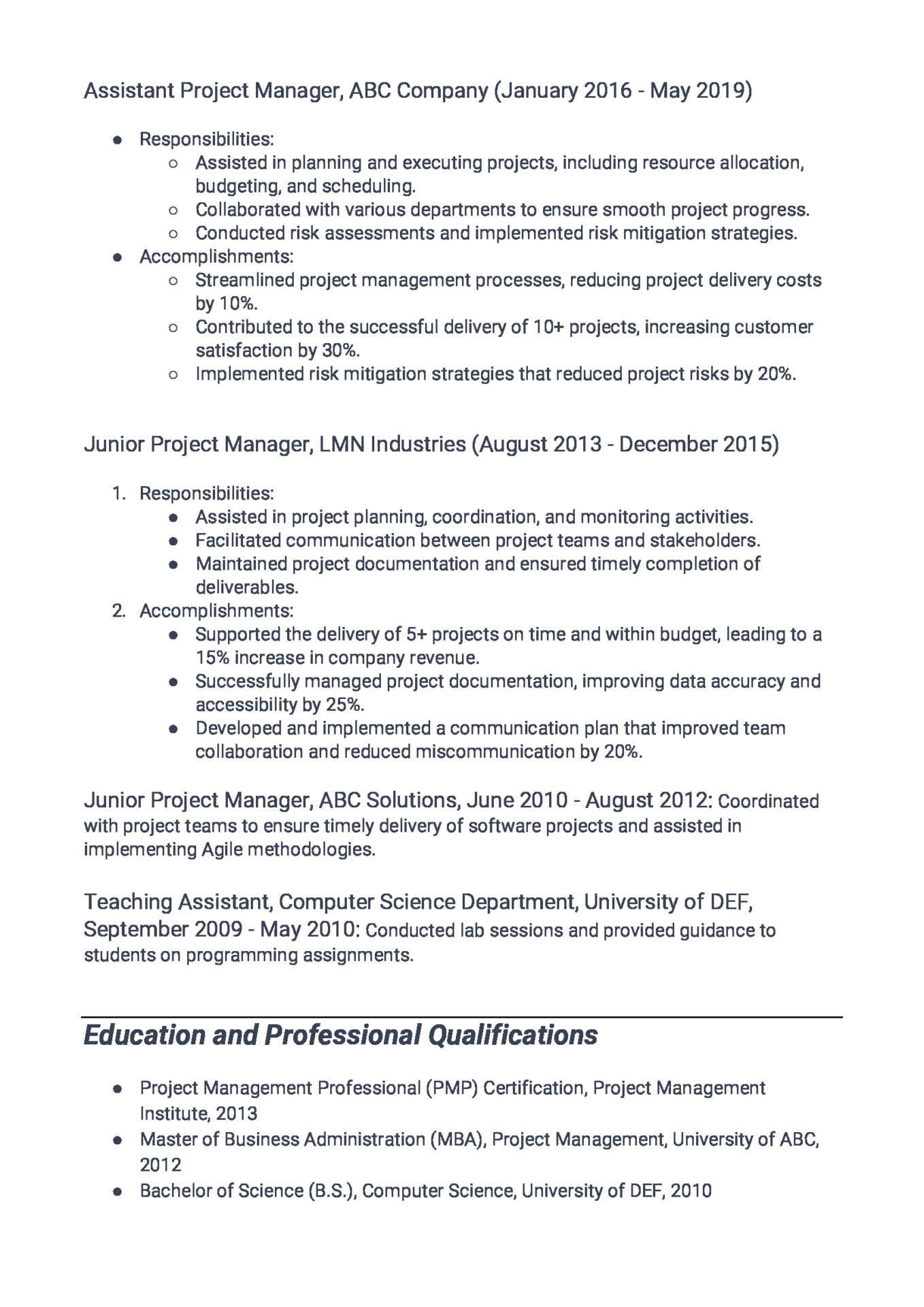
Page 1

Project Manager CV Example

Page 2

Project Manager CV example page 2

FAQ

Q: How should I prioritize my skills and experiences when tailoring my CV to a specific Project Manager job posting?
A: Review the job description carefully and identify the most important skills, experiences, and qualifications that the employer is looking for. Prioritize these elements in your CV, highlighting them in your professional summary and employment history sections.

Q: Is it important to include industry-specific experience in my Project Manager CV?
A: Yes, including industry-specific experience can be beneficial, especially if the job posting emphasizes the need for such expertise. If you have relevant experience in the industry, make sure to showcase it in your CV.

Q: Can I include volunteer or charity work in my Project Manager CV?
A: Yes, you can include volunteer or charity work in your CV, particularly if it is relevant to the job you are applying for or demonstrates your project management skills. You can mention this experience in a separate section or incorporate it within your employment history.

« Previous Page

Primary Sidebar

Mike Jacobsen Recruitment Consultant and Career Coach
Contact Us / Write For Us

  • 79 Civil Service Interview Questions (And Example Answers)
  • 94 Project Manager Interview Questions (And Sample Answers)
  • B-STAR Interview Technique - The Best Answer Approach For Application Success
  • Business Analyst Job Interview Question & Example Answers
  • Changing and Improving - Tips for competency based job applications and interviews
  • Civil Service Interviews - Common Questions and How To ACE Them
  • Civil Service Success Profiles Strengths - A Complete Guide To Success
  • Communicating and Influencing - Tips for competency based job applications and interviews
  • Delivering at Pace - What Does it Mean to Deliver at Pace AND How to Showcase Your Abilities During a Job Application
  • Developing Self and Others - Tips for competency based job applications and interviews
  • Free CV Template
  • How to Become a Business Analyst
  • How to Get a Business Analyst Job With No Experience or Qualifications
  • How to Write a Business Analyst CV / Resume (With Examples)
  • Job Description Buzzwords - What Exactly Do Hiring Managers Mean By Some Of The Terms They Use?
  • Leadership Behaviour (Success Profiles) - Tips for competency based job applications and interviews
  • Let Us Help You Land Your Dream Job
  • Making Effective Decisions - Tips for competency based job applications and interviews
  • Managing a Quality Service - How to Showcase your Service Management Abilities During a Job Application
  • Privacy Policy
  • Reasons to Become a Business Analyst
  • Seeing the Big Picture - Being aware of how your actions impact the wider project or organisation
  • Should You Write A Cover Letter When Applying For Jobs?
  • Submission Successful
  • Understanding Civil Service Behaviours - Complete Guide to Application Success
  • Working Together - Tips for competency based job applications and interviews

Copyright © 2024 · Magazine Pro on Genesis Framework · WordPress · Log in